ZHUBEI CITY, June 1, 2026 /PRNewswire/ -- Airoha Technology today announced its inaugural exhibition at the ePaper Pavilion during Computex 2026. Leveraging 20 years of deep technological expertise in wireless transmission, Airoha's Bluetooth® audio chips have earned widespread adoption and validation from global Tier-1 acoustic brands.
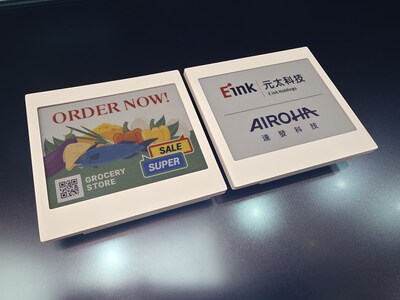
Building on this robust foundation, Airoha is expanding its footprint in the "Short-range Wireless" IC market in 2026, officially extending its reach from audio into Bluetooth® data transmission. Markedly, Airoha is the world's first IC designer to realize the 4.2-inch Ripple™ ESL (Electronic Shelf Label) chip, demonstrating its exceptional wireless technology prowess in anti-interference and transmission reliability.
Unlocking Diverse Commercial Scenarios: Global Debut of the 4.2-Inch Ripple™ ESL
E Ink, the global leader in ePaper display technology, continues to pioneer new form factors for ESL products. Leveraging E Ink's innovative waveform and algorithm architecture, the two companies are jointly showcasing the Ripple ESL, a solution engineered to mitigate flashing. This technology utilizes a wave-like "Ripple" animation effect for screen transitions, significantly reducing the flashing sensation typical of traditional ePaper page turns. This delivers smoother visual updates—crucial elements for dynamic Retail Media Networks (RMN) and point-of-purchase advertising.
"E Ink continuously refines ePaper technology to enhance color performance, further driving the penetration of ePaper applications in the advertising sector," said JM Hung, General Manager of E Ink. "For our first small-format ESL product, we partnered with Airoha Technology, an IC design powerhouse renowned for its robust Bluetooth® wireless stability and exceptional anti-interference capabilities. Together, we are establishing a new technological milestone for diverse commercial applications across retail, logistics, and beyond."
The World's First Ripple ESL Chip: Airoha's New AB161x Bluetooth Series
Airoha Technology's newly launched AB161x series chips support all types of ESLs adopting the Bluetooth® SIG 5.4 standard. The exclusive new-generation 4.2-inch small-format Ripple™ ESL not only diversifies application environments but also specifically fulfills the emerging retail media demand for shelf labels that double as high-impact visual advertising mediums.
"Over the past two decades, Airoha Technology has accumulated rich wireless communication technology and customer service experience in the Bluetooth® audio sector," stated YuChuan Yang, Senior Vice President at Airoha Technology. "Our Bluetooth® transmission chips demonstrate strong commercialization capabilities across diverse wireless communication scenarios. Not only have we expanded into the ESL ePaper application market, but we have also achieved mass production in our gaming HID (Human Interface Device) product lines. Centered on our deep foundational Bluetooth® wireless technology, we will continue to collaborate with global partners to pioneer broader commercial application markets."
 View original content:https://www.prnewswire.co.uk/news-releases/airoha-technology-partners-with-e-ink-for-global-debut-of-4-2-inch-ripple-esl-at-computex-2026--302786979.html

Im Gotthardmassiv im Tessin ist einem internationalen Forschungsteam erstmals gelungen, die Erde kontrolliert zum Beben zu bringen. Im Untergrundlabor "Bedrettolab", das in einem ehemaligen Baustollen des Furkatunnels eingerichtet wurde, lösten Wissenschaftlerinnen und Wissenschaftler gezielt eine Serie von Mikrobeben aus. Die beteiligte Rheinisch-Westfälische Technische Hochschule Aachen (RWTH Aachen) sprach von einem "sehr erfolgreichen" Versuch.
Über mehrere Tage injizierten Fachleute der ETH Zürich, der RWTH Aachen und des italienischen Nationalen Instituts für Geophysik und Vulkanologie (INGV) Wasser mit hohem Druck in eine natürliche Bruchzone tief im Fels. Ziel des Experiments war es, Spannungsänderungen im Gestein hervorzurufen und damit kleinste Erschütterungen auszulösen. Genau das trat ein: Registriert wurde eine ganze Serie von Mikrobeben, teilweise mit Magnituden knapp unterhalb von 0. An der Erdoberfläche waren diese Ereignisse nicht zu spüren.
Um die künstlich erzeugten Beben detailliert zu erfassen, installierte das Team Hunderte hochsensibler Sensoren in unmittelbarer Nähe der Verwerfung. Die Messinstrumente reagierten so feinfühlig, dass im Bedrettolab sogar das Erdbeben in Japan vom 20. April präzise aufgezeichnet werden konnte. Durch die direkte Platzierung an der Bruchzone konnte die Entstehung der Erschütterungen erstmals am Ursprungsort und nicht wie sonst üblich an der Erdoberfläche verfolgt werden. Die aufgezeichneten Signale seien "unglaublich", sagte Projektleiter Florian Amann von der RWTH Aachen, man erhalte einen einzigartigen Einblick in die Erdbebenphysik.
Das Experiment ist Teil des Projekts "FEAR" – kurz für "Fault Activation and Earthquake Rupture". Langfristig sollen die Daten dazu beitragen, die Vorhersagbarkeit von Erdbeben zu verbessern. Im Fokus steht die Frage, was im Gestein passiert, bevor ein größeres Beben einsetzt. Nach Angaben der Forschenden gehen starken Erdbeben typischerweise tausende kleine Ereignisse voraus. Deren Entwicklung im Labor nachzuzeichnen, soll helfen, die physikalischen Prozesse entlang natürlicher Störungszonen besser zu verstehen und Frühindikatoren für künftige Beben zu identifizieren.