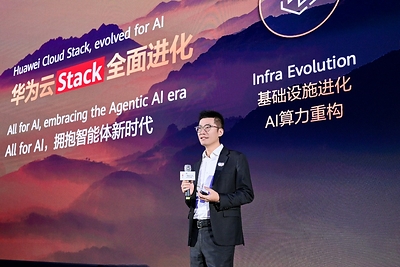
SHANGHAI, Sept. 18, 2026 /PRNewswire/ -- At HUAWEI CONNECT 2026, Huawei hosted the Huawei Cloud Summit under the theme "Agentic Hybrid Cloud: Powering a New Era of Intelligence." Antonony Gu, President of Huawei Hybrid Cloud, delivered a keynote speech at the summit, discussing the changes driven by AI agents, Huawei Cloud Stack's evolution across four key areas—cloud infrastructure, data, AI, and ecosystem—guided by the principle of "All for AI", and its commitment to helping enterprises embrace the agentic AI era.
AI agents are among the most significant developments in AI today. Agents for coding, workplaces, design, customer service, marketing, and more are rapidly redefining how businesses get done. Antonony Gu highlighted that the rapid adoption of AI agents is driving three fundamental changes:
Addressing these changes, Huawei Cloud has introduced an AI agent-ready hybrid cloud architectureNext, comprising four key capabilities: an agile, elastic cloud infrastructure designed for continuous evolution and unified general-purpose and AI compute; an AI-native capability hub that connects data, compute, and tokens; an agent-native enablement platform for developing and running AI agents at scale; and intelligent operations and end-to-end security capabilities covering the entire AI agent lifecycle. Antonony Gu emphasized, "As AI agent adoption continues to accelerate over the next three to five years, a deterministic hybrid cloud architecture is a clear path forward for enterprises in the agentic world."
As the agentic AI era approaches, Huawei Cloud Stack is evolving across four key areas: infrastructure, data, AI, and ecosystem.
The agentic AI era is opening up new possibilities for enterprises. Looking ahead, Huawei Cloud Stack, guided by the principle of "All for AI," will continue to invest heavily in Agentic Infra, data, and AI. Together with partners, Huawei Cloud Stack will foster an open ecosystem, helping enterprises build, use, and manage cloud environments efficiently and bring AI into production across industries.
 View original content to download multimedia:https://www.prnewswire.co.uk/news-releases/antonony-gu-huawei-cloud-all-for-ai-huawei-cloud-stack-powers-a-new-era-of-intelligence-302883061.html

Eine anonyme E-Mail an die US-Botschaft in Bern hat kurz vor dem Auftritt von US-Präsident Donald Trump beim Weltwirtschaftsforum in Davos ein Ermittlungsverfahren der Schweizer Bundesanwaltschaft ausgelöst – und zur Festnahme einer WEF-Mitarbeiterin geführt. Inzwischen ist klar: Die gegen die IT-Expertin erhobenen Vorwürfe eines geplanten Attentats waren nicht zu belegen. Die Bundesanwaltschaft teilte mit, die in der Sache eröffneten Ermittlungen wegen strafbarer Vorbereitungshandlungen zu einem Mord seien eingestellt worden.
Die Warnmail war laut Medienberichten der Tamedia-Gruppe wenige Stunden vor Trumps Rede eingegangen. Der anonyme Absender schilderte in fehlerhaftem Englisch eine angeblich „dringliche Bedrohung“ für das Leben des US-Präsidenten in Davos und bezeichnete die später festgenommene Frau iranischer Herkunft als Agentin, die eine entsprechende Operation koordiniert habe. Die US-Botschaft leitete den Hinweis an die Schweizer Behörden weiter; diese erklärten, sie hätten die Warnung „sehr ernst“ genommen und seien „sofort aktiv“ geworden.
Tatsächlich arbeitete die Beschuldigte nicht am Tagungsort in Davos, sondern in der WEF-Zentrale im Genfer Vorort Cologny. Dort wurde sie nach Angaben der Bundesanwaltschaft festgenommen, mehrere Stunden lang bis tief in die Nacht vernommen und ihre Telefone sowie ihr Computer wurden beschlagnahmt und ausgewertet. Im Zuge dieser Maßnahmen habe sich jedoch gezeigt, dass sich keiner der in der anonymen E-Mail erhobenen Punkte erhärten ließ. Für alle Aspekte der Anschuldigungen seien keine Beweise gefunden worden, hieß es zur Begründung für die Einstellung des Verfahrens.
Die betroffene Mitarbeiterin, eine gebürtige Iranerin, war nach den Medienberichten kurz nach dem Vorfall beim WEF nicht mehr beschäftigt. Zu den Gründen äußerte sich die Organisation nicht; auf entsprechende Anfragen gab es zunächst keine Stellungnahme. Damit bleiben nach dem spektakulären Fehlalarm vorerst Fragen offen – etwa zur Herkunft und Glaubwürdigkeit des anonymen Hinweises –, während die Schweizer Strafverfolger den Fall strafrechtlich abgeschlossen haben.