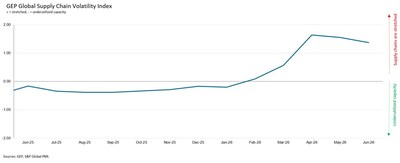
CLARK, N.J., July 13, 2026 /PRNewswire/ -- GEP Global Supply Chain Volatility Index — a leading indicator of supply-chain conditions based on a monthly survey of 27,000 businesses — showed global supply chain pressures remained elevated in June despite falling oil prices and lower transportation costs, reflecting uncertainty surrounding the US-Iran ceasefire.
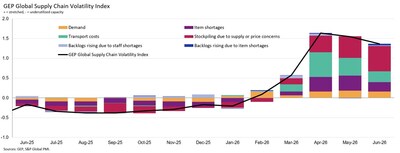
Reports from manufacturers of backlogs rising due to shortages of critical inputs were their highest since late 2022. The data suggests supply-chain bottlenecks are likely to persist into at least the third quarter as businesses wait for materials needed to complete customer orders.
To guard against further disruption, manufacturers continued building buffer inventories in June. Reports of safety stockpiling increased again and remained at their highest level since January 2023.
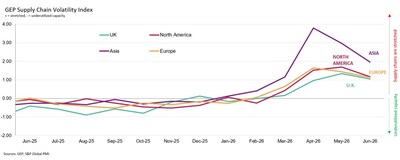
Demand for raw materials, commodities and intermediate goods remained strong across North America and Asia, reinforcing expectations that supply-chain activity will stay elevated in the coming months as inventories are replenished and existing orders are fulfilled. In contrast, input demand weakened across Europe.
"The rise in stockpiling and persistent order backlogs point to one clear conclusion: businesses still don't trust the global trading environment to remain stable," said John Piatek, vice president, consulting, GEP. "Despite lower oil prices and easing transportation costs, companies continue buying ahead because they expect further disruption. While this is encouraging for the global economy in the near term, it also shows manufacturers remain very cautious and are planning for more disruption in international trade."
Interpreting the data:
Index > 0, supply chain capacity is being stretched. The further above 0, the more stretched supply chains are.
Index < 0, supply chain capacity is being underutilized. The further below 0, the more underutilized supply chains are.
JUNE 2026 REGIONAL KEY FINDINGS
JUNE 2026 KEY FINDINGS
For more information, visit www.gep.com/volatility.
Note: Full historical data dating back to January 2005 is available for subscription. Please contact economics@spglobal.com.
The next release of the GEP Global Supply Chain Volatility Index will be 8 a.m. ET, Aug. 12, 2026.
About the GEP Global Supply Chain Volatility Index
The GEP Global Supply Chain Volatility Index is produced by S&P Global and GEP. It is derived from S&P Global's PMI® surveys, sent to companies in over 40 countries, totaling around 27,000 companies. The headline figure is a weighted sum of six sub-indices derived from PMI data, PMI Comments Trackers and PMI Commodity Price & Supply Indicators compiled by S&P Global.
A Supply Chain Volatility Index is also published at a regional level for Europe, Asia, North America and the U.K. For more information about the methodology, click here.
About GEP
GEP® delivers AI-native procurement and supply chain solutions that help global enterprises become more agile and resilient, operate more efficiently and effectively, gain competitive advantage, boost profitability and increase shareholder value. Fresh thinking, innovative products, unrivaled domain expertise, smart, passionate people — this is how GEP SOFTWARE™, GEP STRATEGY™ and GEP MANAGED SERVICES™ together deliver procurement and supply chain solutions of unprecedented scale, power and effectiveness. Our customers are the world's best companies, including more than 1,000 Fortune 500 and Global 2000 industry leaders who rely on GEP to meet ambitious strategic, financial and operational goals. A leader in multiple Gartner Magic Quadrants, GEP's cloud-native software and digital business platforms consistently win awards and recognition from industry analysts, research firms and media outlets, including Gartner, Forrester, IDC, ISG, and Spend Matters. GEP is also regularly ranked a top procurement and supply chain consulting and strategy firm, and a leading managed services provider by ALM, Everest Group, NelsonHall, IDC, ISG and HFS, among others. Headquartered in Clark, New Jersey, GEP has offices and operations centers across Europe, Asia, Africa and the Americas. To learn more, visit www.gep.com.
Media Contacts
Derek Creevey | Joe Hayes | S&P Global Market Intelligence |
Director, Public Relations | Senior Principal Economist | Corporate Communications |
GEP | S&P Global Market Intelligence | Email: Press.mi@spglobal.com |
Phone: +1 646-276-4579 | Phone: +44-1344-328-099 | |
Email: derek.creevey@gep.com | Email: joe.hayes@spglobal.com |

 View original content to download multimedia:https://www.prnewswire.co.uk/news-releases/businesses-continue-building-buffer-stocks-in-anticipation-of-further-disruption-as-supply-shortages-persist-gep-global-supply-chain-volatility-index-302822818.html

Der Bundesrat verschärft im Streit um das Frühfranzösisch den Ton und greift zu einem bundesrechtlichen Instrument. Alle Primarschülerinnen und Primarschüler in der Schweiz sollen künftig zwingend eine zweite Landessprache lernen. Um dieses Ziel durchzusetzen, hat die Landesregierung eine Revision des Sprachengesetzes in die Vernehmlassung geschickt. Sie reagiert damit auf Vorstösse in mehreren deutschsprachigen Kantonen, Französisch aus den Stundenplänen der Primarschule zu streichen.
Im Zentrum steht die Frage, welche Rolle die Landessprachen im obligatorischen Unterricht spielen sollen. Für den Bundesrat ist dies eine «Frage von nationaler Bedeutung». Die Bundesverfassung verpflichte Bund und Kantone gemeinsam, die Landessprachen zu erhalten, die Verständigung zwischen den Sprachgemeinschaften zu stärken und nationale Minderheiten zu schützen, hält die Regierung fest. Der Bund sehe sich damit in der Verantwortung, den Zusammenhalt zwischen den Sprachregionen und den Respekt vor der sprachlichen Vielfalt zu sichern, während die Kantone ihr Schulwesen so zu harmonisieren hätten, dass Qualität und Durchlässigkeit des Bildungsraums Schweiz gewahrt bleiben.
Der Konflikt entzündet sich an der 2004 beschlossenen Sprachenstrategie der Kantone, die 2009 im HarmoS-Konkordat verankert wurde. Diese sieht vor, dass Kinder in der Primarschule zwei Fremdsprachen erlernen – darunter eine zweite Landessprache. In einzelnen Kantonen gibt es inzwischen Bestrebungen, den Unterricht einer Landessprache als Fremdsprache auf der Primarstufe zu streichen. Das widerspreche der gemeinsamen Strategie, schreibt der Bundesrat und zeigt sich über diese Entwicklung «beunruhigt».
Um gegenzusteuern, legt die Regierung zwei Varianten für eine Gesetzesänderung vor. Die erste folgt dem HarmoS-Modell: In der Primarschule sollen obligatorisch zwei Fremdsprachen unterrichtet werden, eine Landessprache und Englisch. Damit würde die heutige Praxis in den 15 HarmoS-Kantonen bundesrechtlich abgesichert und für alle gelten, sollte es nötig werden. Die zweite Variante lässt den Kantonen mehr Spielraum: Sie verpflichtet lediglich dazu, dass eine zweite Landessprache spätestens ab der Primarschule und durchgehend bis zum Ende der obligatorischen Schulzeit unterrichtet wird, ohne Englisch explizit als zweite Fremdsprache vorzuschreiben.
Mit der Revision will der Bundesrat den Rahmen abstecken für den Fall, dass die Kantone ihre Sprachenstrategie ganz oder teilweise aufgeben. Konkrete Entscheide sind noch offen: Zunächst läuft bis zum 5. Oktober 2026 eine Vernehmlassung, in der Kantone, Parteien und weitere Akteure Stellung beziehen können. Erst danach wird sich zeigen, ob sich das strengere HarmoS-Modell oder die flexibelere Lösung durchsetzt – und wie viel Gewicht der Bund seiner sprachpolitischen Rolle im Schulbereich tatsächlich geben will.