CLARK, N.J., May 13, 2026 /PRNewswire/ -- GEP Global Supply Chain Volatility Index, based on a monthly survey of 27,000 businesses, shows that global supply chain pressures surged in April to their highest level since the pandemic-era disruptions of late 2022, as the war in the Middle East fueled inflation fears, shortages and aggressive stockpiling by manufacturers worldwide. The GEP Global Supply Chain Volatility Index jumped to 1.64 in April, from 0.57 in March, its highest reading since October 2022.
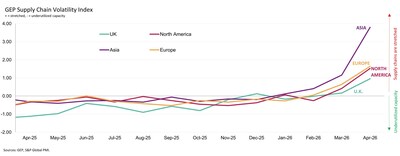
Businesses globally ramped up safety stockpiling of goods and raw materials at the fastest rate in three years as they seek to secure supply ahead of further price rises and disruption. European manufacturers reported the most aggressive inventory building, signaling heightened concern over supply availability and costs.
The rush to build inventories pushed global purchasing activity to its strongest level in more than four years and intensified pressure on suppliers. Reports of item shortages rose to their highest level since November 2022.
Asia reported the sharpest deterioration in supply chain conditions during April, driven by surging transportation costs, worsening shortages and rising purchasing activity. Bottlenecks also intensified significantly across Europe and North America.
Global transportation costs climbed to a record high in April, reflecting maritime disruption, soaring fuel prices and logistical challenges linked to the war in the Middle East.
"Even if tensions in the Middle East ease quickly, global supply chains are unlikely to normalize for another six to 12 months," said John Piatek, vice president, consulting, GEP. "What stands out in April's data is how broadly the disruption is spreading. Shortages worsened across every major region, signaling this is no longer an isolated transport shock. Companies worldwide are now scrambling to secure supply and protect themselves against further inflation and disruption."
Interpreting the data:
Index > 0, supply chain capacity is being stretched. The further above 0, the more stretched supply chains are.
Index < 0, supply chain capacity is being underutilized. The further below 0, the more underutilized supply chains are.
APRIL 2026 REGIONAL KEY FINDINGS
APRIL 2026 KEY FINDINGS
For more information, visit www.gep.com/volatility.
Note: Full historical data dating back to January 2005 is available for subscription. Please contact economics@spglobal.com.
The next release of the GEP Global Supply Chain Volatility Index will be 8 a.m. ET, Jun. 10, 2026.
About the GEP Global Supply Chain Volatility Index
The GEP Global Supply Chain Volatility Index is produced by S&P Global and GEP. It is derived from S&P Global's PMI® surveys, sent to companies in over 40 countries, totaling around 27,000 companies. The headline figure is a weighted sum of six sub-indices derived from PMI data, PMI Comments Trackers and PMI Commodity Price & Supply Indicators compiled by S&P Global.
A Supply Chain Volatility Index is also published at a regional level for Europe, Asia, North America and the U.K. For more information about the methodology, click here.
About GEP
GEP® delivers AI-powered procurement and supply chain solutions that help global enterprises become more agile and resilient, operate more efficiently and effectively, gain competitive advantage, boost profitability and increase shareholder value. Fresh thinking, innovative products, unrivaled domain expertise, smart, passionate people — this is how GEP SOFTWARE™, GEP STRATEGY™ and GEP MANAGED SERVICES™ together deliver procurement and supply chain solutions of unprecedented scale, power and effectiveness. Our customers are the world's best companies, including more than 1,000 Fortune 500 and Global 2000 industry leaders who rely on GEP to meet ambitious strategic, financial and operational goals. A leader in multiple Gartner Magic Quadrants, GEP's cloud-native software and digital business platforms consistently win awards and recognition from industry analysts, research firms and media outlets, including Gartner, Forrester, IDC, ISG, and Spend Matters. GEP is also regularly ranked a top procurement and supply chain consulting and strategy firm, and a leading managed services provider by ALM, Everest Group, NelsonHall, IDC, ISG and HFS, among others. Headquartered in Clark, New Jersey, GEP has offices and operations centers across Europe, Asia, Africa and the Americas. To learn more, visit www.gep.com.
Disclaimer
The intellectual property rights to the data provided herein are owned by or licensed to S&P Global and/or its affiliates. Any unauthorised use, including but not limited to copying, distributing, transmitting or otherwise of any data appearing is not permitted without S&P Global's prior consent. S&P Global shall not have any liability, duty or obligation for or relating to the content or information ("Data") contained herein, any errors, inaccuracies, omissions or delays in the Data, or for any actions taken in reliance thereon. In no event shall S&P Global be liable for any special, incidental, or consequential damages, arising out of the use of the Data. Purchasing Managers' Index™ and PMI® are either trade marks or registered trade marks of S&P Global Inc or licensed to S&P Global Inc and/or its affiliates.
This Content was published by S&P Global Market Intelligence and not by S&P Global Ratings, which is a separately managed division of S&P Global. Reproduction of any information, data or material, including ratings ("Content") in any form is prohibited except with the prior written permission of the relevant party. Such party, its affiliates and suppliers ("Content Providers") do not guarantee the accuracy, adequacy, completeness, timeliness or availability of any Content and are not responsible for any errors or omissions (negligent or otherwise), regardless of the cause, or for the results obtained from the use of such Content. In no event shall Content Providers be liable for any damages, costs, expenses, legal fees, or losses (including lost income or lost profit and opportunity costs) in connection with any use of the Content.
Media Contacts
Derek Creevey | Joe Hayes | S&P Global Market Intelligence |
Director, Public Relations | Principal Economist | Corporate Communications |
GEP | S&P Global Market Intelligence | Email: Press.mi@spglobal.com |
Phone: +1 646-276-4579 | Phone: +44-1344-328-099 | |
Email: derek.creevey@gep.com | Email: joe.hayes@spglobal.com |
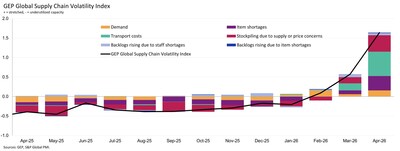

Photo - https://mma.prnewswire.com/media/2978569/GEP_SCVI_ALL.jpg
Photo - https://mma.prnewswire.com/media/2978568/GEP_SCVI_breakdown.jpg
Logo - https://mma.prnewswire.com/media/518346/GEP_Logo.jpg

SPD-Chef und Bundesfinanzminister Lars Klingbeil erhöht den Druck bei der geplanten Reform der Einkommenssteuer. In den kommenden Wochen will er sein Konzept vorlegen, an dem nach seinen Worten "mit Hochdruck" gearbeitet wird. Ziel ist eine signifikante finanzielle Besserstellung für Haushalte mit geringen und mittleren Einkommen. "Diejenigen, die jeden Tag den Laden am Laufen halten, müssen am Ende mehr in der Tasche haben", sagte Klingbeil der Süddeutschen Zeitung.
Die Koalitionspartner SPD und Union haben sich darauf verständigt, eine umfassende Änderung der Einkommensteuer zum 1. Januar 2027 in Kraft zu setzen. Nach bisherigen Aussagen Klingbeils sollen bis zu 95 Prozent der Arbeitnehmer entlastet werden – "merklich, mit einigen hundert Euro im Jahr". Für viele Beschäftigte, etwa in Ballungsräumen wie Köln, könnte das eine spürbare Verbesserung der finanziellen Spielräume bedeuten. Über die konkrete Ausgestaltung der Tarife ist bislang jedoch nichts entschieden.
Strittig ist vor allem die Gegenfinanzierung der Reform, deren Volumen auf einen Milliardenbetrag geschätzt wird. Klingbeil stellt klar, dass aus seiner Sicht Spitzenverdiener mit sechsstelligen Gehältern stärker herangezogen werden sollen: "Spitzenverdiener mit sechsstelligen Gehältern müssen hierzu ihren Beitrag leisten." Die Sozialdemokraten favorisieren grundsätzlich eine stärkere Besteuerung hoher Einkommen sowie von Erbschaften, um die Entlastung der unteren und mittleren Einkommensgruppen zu ermöglichen.
Aus der Union kommt Widerstand gegen diesen Umverteilungskurs. Kritiker dort verlangen, ein wesentlicher Teil der Finanzierung müsse über Einsparungen im Bundeshaushalt erfolgen. Der CDU-Abgeordnete Mathias Middelberg sieht insbesondere bei Finanzhilfen des Bundes für Länder und Gemeinden Spielraum. Diese Zuweisungen seien in den vergangenen sieben Jahren von rund acht auf fast 60 Milliarden Euro angestiegen. Die unterschiedlichen Vorstellungen über Steuererhöhungen für Topverdiener einerseits und Ausgabenkürzungen andererseits markieren die zentrale Konfliktlinie, bevor Klingbeil sein Reformkonzept offiziell vorlegt.

 View original content: