FREMONT, Calif., Sept. 29, 2026 /PRNewswire/ -- Leopard Imaging® will showcase its latest camera technologies and AI perception platforms at VISION 2026, taking place October 6–8, 2026, in Stuttgart, Germany.
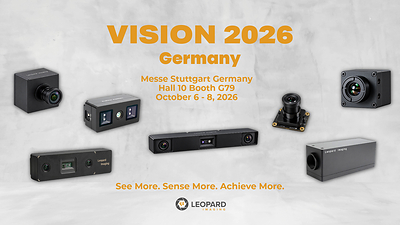
Visitors can meet the Leopard Imaging team at Hall 10, Booth 10G79, where the company will present a broad portfolio of live demonstrations for robotics, industrial automation, autonomous systems, machine vision, and edge AI applications.
Sirius Max with Lumotive LCM Technology – Long-Range 3D Perception
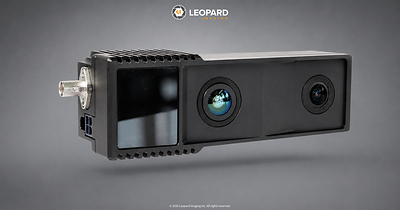
Sirius Max is a compact RGB + depth perception platform combining intelligent iToF depth sensing, programmable beam-steered illumination, and embedded synchronization. Designed for robotics and autonomous systems, the solution supports software-defined scanning and long-range 3D perception.
ASTRO Stereo Camera – High-Bandwidth RGB-IR Perception
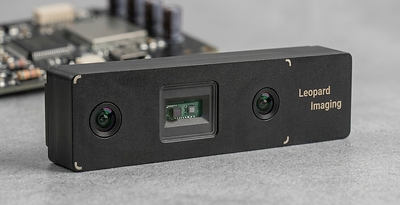
The ASTRO Stereo Camera integrates dual 5.1MP BSI global-shutter sensors, IR projection and illumination, and NVIDIA® Holoscan 10GigE connectivity. Demonstrated on the NVIDIA Jetson Thor platform, ASTRO supports synchronized RGB + IR stereo imaging, depth perception, 3D reconstruction, and AI perception pipelines.
IMX530 – High-Resolution Industrial AI Imaging
Built around the Sony 25MP IMX530 global-shutter sensor, this NVIDIA Holoscan 10GigE camera solution combines high-resolution imaging with FPGA processing for industrial inspection, barcode recognition, logistics automation, and other demanding machine vision applications.
Hybrid iToF RGB-D Camera – High-Precision Depth Sensing
The Hybrid iToF camera combines pulsed and phased indirect Time-of-Flight technologies with onsemi 1.2MP depth sensor. It is designed to provide high depth precision and reduced interference for robotics, 3D mapping, gesture recognition, and AR/VR applications.
IMX454 – Multispectral Imaging
The IMX454-based multispectral camera provides 41 spectral channels from 450 to 850 nm with 1948 × 1097 resolution at 30 FPS. The USB 3.0 UVC solution supports agriculture, food inspection, environmental monitoring, spectral analysis, and intelligent vision applications.
Dragonfly USB 3.0 YUV – 4K Camera with Integrated ISP
Dragonfly combines one onsemi 4K HyperLux LP sensor, integrated ISP, HDR imaging, and USB 3.0 connectivity. Its plug-and-play architecture is well suited for AI vision prototyping, smart kiosks, video conferencing, and industrial vision systems.
DragonFire – Real-Time Thermal Perception
DragonFire is an uncooled infrared camera delivering 640 × 512 resolution at 30/60 FPS with a 12 μm pixel size and NETD performance of ≤40 mK. Its GMSL2 interface supports robotics, industrial inspection, autonomous systems, and thermal monitoring applications.
Eagle 1 – RGB-IR Active Stereo Vision
Eagle 1 integrates two 5.1MP BSI global-shutter RGB-IR sensors, active IR illuminator, and a dot-pattern projector. The camera delivers RAW RGB and IR data for depth perception, intelligent navigation, robotics, and autonomous machines.
These demonstrations highlight our latest advances in AI perception. We welcome you to visit us to experience the technologies firsthand and meet our team.
About Leopard Imaging
Leopard Imaging is a global leader in AI perception and spatial intelligence solution design and manufacturing, delivering advanced imaging technologies for autonomous systems, robotics, AIoT, automotive, industrial automation, healthcare, and edge AI applications.
Media Contact
Leopard Imaging Marketing Team
Ariel Zhang
marketing@leopardimaging.com
 View original content to download multimedia:https://www.prnewswire.co.uk/news-releases/leopard-imaging-to-showcase-advanced-ai-perception-and-imaging-solutions-at-vision-2026-302891998.html

Während die Dieselpreise in Teilen Italiens neue Höchststände erreichen, zeichnet sich in Luxemburg eine spürbare Entspannung ab – und in Deutschland profitieren Autofahrer nur eingeschränkt von Steuererleichterungen. In Südtirol kletterte der Dieselhöchstpreis in Bozen Medienberichten zufolge auf 2,288 Euro pro Liter und lag damit am Mittwoch über dem Durchschnitt auf den italienischen Autobahnen. Dort wurden im Schnitt 2,287 Euro pro Liter Diesel fällig. Im gesamtstaatlichen Vergleich ist Südtirol damit weiterhin Spitzenreiter bei den Preisen.
Auch in anderen italienischen Regionen zogen die Dieselpreise deutlich an. In Trient stieg der Selbstbedienungspreis auf 2,274 Euro pro Liter, ein Anstieg um 1,1 Cent binnen eines Tages. Die stärksten Preissprünge wurden jedoch nicht in den teuersten Regionen verzeichnet, sondern im Nordosten und im Westen des Landes: In Friaul verteuerte sich ein einmaliges Volltanken von 50 Litern Diesel um 1,25 Euro, in Ligurien um 1,20 Euro, im Latium um 1,15 Euro. Auf den Autobahnen wurden Tagesanstiege von bis zu zwei Cent je Liter registriert. Der Präsident der nationalen Verbraucherunion, Massimiliano Dona, wirft der Regierung in Rom vor, zu wenig gegen die Preisanstiege zu unternehmen, und warnt vor möglichen Folgen für die Inflation.
Parallel dazu zeigt sich in Luxemburg ein gegenteiliger Trend. Dort wird Diesel nach Angaben des Wirtschaftsministeriums ab Mitternacht um 6,2 Cent je Liter günstiger und kostet dann 1,995 Euro. Damit fällt der Preis unter die Marke von zwei Euro. Die Benzinsorten Super 95 und Super 98 bleiben stabil bei 1,837 Euro beziehungsweise 2,049 Euro je Liter. Auch Heizöl wird in Luxemburg billiger: Bei Abnahme von mindestens 1.500 Litern sinkt der Literpreis am Mittwoch ebenfalls um 6,2 Cent auf 1,477 Euro. Der Großherzogtum bewegt sich damit preislich klar unter dem Niveau vieler Regionen in Italien.
In Deutschland wiederum kommt eine bereits beschlossene Steuerentlastung für Autofahrer nur begrenzt an. In Sachsen-Anhalt senkte die Bundesregierung vor rund einer Woche die Steuern auf Kraftstoffe um 17 Cent pro Liter. Laut dem Portal Benzinpreis-blitz kostete Super E10 am Mittwochnachmittag im Landesdurchschnitt 2,12 Euro pro Liter und damit lediglich rund sieben Cent weniger als am Nachmittag vor Inkrafttreten des Rabatts. Der Dieselpreis lag bei 2,19 Euro pro Liter, rund 15 Cent unter dem Vorkrisenniveau. Die Entlastung erreicht damit nicht vollständig die angekündigte Höhe, zudem spielt laut den Erhebungen die Uhrzeit eine wesentliche Rolle: Je nach Tageszeit fällt der Vorteil für Verbraucher unterschiedlich aus.
Im europäischen Vergleich entstehen damit deutliche Preisunterschiede für Dieselverbraucher. Während Italien mit Rekordständen in Teilen des Landes und spürbaren Tagesanstiegen im Fokus steht, nutzt Luxemburg den Spielraum für Preissenkungen. Deutschland versucht, über Steuersenkungen gegenzusteuern, bislang mit begrenzter Durchschlagskraft an der Zapfsäule. Für Verbraucher bleibt das Umfeld volatil – und die Frage, in welchem Umfang staatliche Eingriffe und Marktbewegungen künftig tatsächlich im Portemonnaie der Autofahrer ankommen.