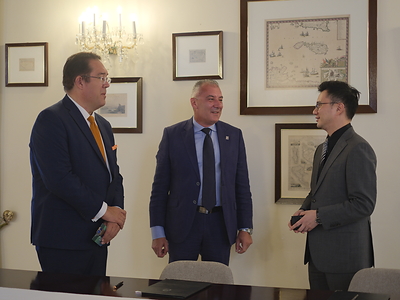
VALLETTA, Malta, Oct. 12, 2026 /PRNewswire/ -- On the sidelines of the 2026 WTTC Global Summit held in Malta, Carlo Micallef, CEO of the Malta Tourism Authority, met with Edison Chen, Vice President of Trip.com Group, for talks on China–Malta tourism cooperation. Witnessed by Jo Etienne Abela, Malta's Minister for Tourism, the Malta Tourism Authority and Trip.com Group formally signed the 2026–2029 Strategic Cooperation Memorandum of Understanding.
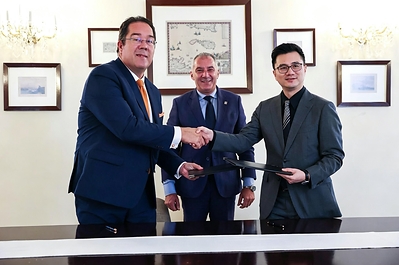
The signing of the Strategic Cooperation MOU marks a further deepening of the strategic partnership between the Malta Tourism Authority and Trip.com Group. Over the next three years, the two parties will carry out in-depth cooperation in destination promotion, tourism product diversification and sustainable tourism.
"Malta is committed to diversifying its source markets, and China is the most important emerging market in our strategic plans," said Carlo Micallef, CEO of the Malta Tourism Authority. "Our partnership with Trip.com Group will help us reach high-value travellers in China and around the world more precisely, and showcase Malta's unique appeal as a premium Mediterranean tourism destination."
Edison Chen, Vice President of Trip.com Group, said, "Malta is a vibrant destination, offering a wealth of cultural and premium experiences, and excellent connectivity. Our data shows a 60% growth in inbound travel bookings to Malta, underscoring its growing appeal among global travellers. By combining Trip.com Group's global reach and platform technology with Malta's unique offerings, we are excited to further boost tourism in Malta, inspiring more travellers from Asia and around the world to discover its beauty."
Malta Accelerates Its Push into the Asian Market
Malta is actively expanding into the Asian market, with plans to raise the share of arrivals from outside the EU to 40% within the next decade. Carlo Micallef, CEO of the Malta Tourism Authority, said that Malta is advancing tourism cooperation discussions with China and several other Asian countries. Although Schengen visa requirements remain a short-term challenge, the market potential is immense.
Trip.com Group's platform coverage advantages across the world's major source markets, together with its leading big-data and AI-supported capabilities, will help Malta enhance its brand influence as a premium tourism destination. With a large presence in Asia, Europe and across global markets, Trip.com Group is highly strategically aligned with the Malta Tourism Authority's market diversification strategy.
The 2026 WTTC Global Summit was held from 7 to 9 October at the Mediterranean Conference Centre in Valletta, bringing together tourism industry CEOs and senior government leaders from more than 100 countries. The signing is one of the significant cooperation outcomes achieved during the Summit. Over the next three years, the two parties will leverage the technological capabilities and data insights of Trip.com Group's global platforms, combined with the Malta Tourism Authority's in-depth understanding and integration of local tourism resources, to continuously optimise promotional strategies and position Malta as a highly attractive Mediterranean tourism destination for global travellers.
About Trip.com Group
Trip.com Group is a global travel service provider comprising of Trip.com, Ctrip, Skyscanner, and Qunar. Across its platforms, Trip.com Group helps travellers around the world make informed and cost-effective bookings for travel products and services and enables partners to connect their offerings with users through the aggregation of travel-related content and resources, and an advanced transaction platform consisting of apps, websites and 24/7 customer service centres. Founded in 1999 and listed on NASDAQ in 2003 and HKEX in 2021, Trip.com Group is on the mission "to pursue the perfect trip for a better world". Find out more about Trip.com Group here: group.trip.com.
Follow us on: X , Facebook , LinkedIn , and YouTube.

 View original content to download multimedia:https://www.prnewswire.co.uk/news-releases/malta-tourism-authority-and-tripcom-group-sign-strategic-cooperation-memorandum-of-understanding-to-promote-malta-as-a-global-destination-302905596.html

Während die Dieselpreise in Teilen Italiens neue Höchststände erreichen, zeichnet sich in Luxemburg eine spürbare Entspannung ab – und in Deutschland profitieren Autofahrer nur eingeschränkt von Steuererleichterungen. In Südtirol kletterte der Dieselhöchstpreis in Bozen Medienberichten zufolge auf 2,288 Euro pro Liter und lag damit am Mittwoch über dem Durchschnitt auf den italienischen Autobahnen. Dort wurden im Schnitt 2,287 Euro pro Liter Diesel fällig. Im gesamtstaatlichen Vergleich ist Südtirol damit weiterhin Spitzenreiter bei den Preisen.
Auch in anderen italienischen Regionen zogen die Dieselpreise deutlich an. In Trient stieg der Selbstbedienungspreis auf 2,274 Euro pro Liter, ein Anstieg um 1,1 Cent binnen eines Tages. Die stärksten Preissprünge wurden jedoch nicht in den teuersten Regionen verzeichnet, sondern im Nordosten und im Westen des Landes: In Friaul verteuerte sich ein einmaliges Volltanken von 50 Litern Diesel um 1,25 Euro, in Ligurien um 1,20 Euro, im Latium um 1,15 Euro. Auf den Autobahnen wurden Tagesanstiege von bis zu zwei Cent je Liter registriert. Der Präsident der nationalen Verbraucherunion, Massimiliano Dona, wirft der Regierung in Rom vor, zu wenig gegen die Preisanstiege zu unternehmen, und warnt vor möglichen Folgen für die Inflation.
Parallel dazu zeigt sich in Luxemburg ein gegenteiliger Trend. Dort wird Diesel nach Angaben des Wirtschaftsministeriums ab Mitternacht um 6,2 Cent je Liter günstiger und kostet dann 1,995 Euro. Damit fällt der Preis unter die Marke von zwei Euro. Die Benzinsorten Super 95 und Super 98 bleiben stabil bei 1,837 Euro beziehungsweise 2,049 Euro je Liter. Auch Heizöl wird in Luxemburg billiger: Bei Abnahme von mindestens 1.500 Litern sinkt der Literpreis am Mittwoch ebenfalls um 6,2 Cent auf 1,477 Euro. Der Großherzogtum bewegt sich damit preislich klar unter dem Niveau vieler Regionen in Italien.
In Deutschland wiederum kommt eine bereits beschlossene Steuerentlastung für Autofahrer nur begrenzt an. In Sachsen-Anhalt senkte die Bundesregierung vor rund einer Woche die Steuern auf Kraftstoffe um 17 Cent pro Liter. Laut dem Portal Benzinpreis-blitz kostete Super E10 am Mittwochnachmittag im Landesdurchschnitt 2,12 Euro pro Liter und damit lediglich rund sieben Cent weniger als am Nachmittag vor Inkrafttreten des Rabatts. Der Dieselpreis lag bei 2,19 Euro pro Liter, rund 15 Cent unter dem Vorkrisenniveau. Die Entlastung erreicht damit nicht vollständig die angekündigte Höhe, zudem spielt laut den Erhebungen die Uhrzeit eine wesentliche Rolle: Je nach Tageszeit fällt der Vorteil für Verbraucher unterschiedlich aus.
Im europäischen Vergleich entstehen damit deutliche Preisunterschiede für Dieselverbraucher. Während Italien mit Rekordständen in Teilen des Landes und spürbaren Tagesanstiegen im Fokus steht, nutzt Luxemburg den Spielraum für Preissenkungen. Deutschland versucht, über Steuersenkungen gegenzusteuern, bislang mit begrenzter Durchschlagskraft an der Zapfsäule. Für Verbraucher bleibt das Umfeld volatil – und die Frage, in welchem Umfang staatliche Eingriffe und Marktbewegungen künftig tatsächlich im Portemonnaie der Autofahrer ankommen.