HANGZHOU, China, May 25, 2026 /PRNewswire/ -- As manufacturing becomes more complex, quality teams require measurement tools that combine precision, portability, and real production readiness. To address this need, SCANOLOGY introduces the AccuArm Portable Coordinate Measuring Machine (PCMM), a high-precision articulated arm designed for flexible inspection across shop floors, assembly lines, and metrology labs.
AccuArm integrates precision hardware, intelligent compensation technologies, and seamless software connectivity into a compact system that supports fixture adjustment, assembly inspection, and large-scale dimensional measurement directly at the point of production.
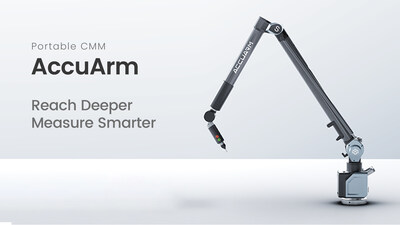
Built with an aerospace-grade carbon-fiber structure and high-precision encoders, AccuArm ensures stable and reliable measurement performance even in demanding industrial environments. The system is certified to ISO 10360-12, delivering trusted accuracy for inspection and verification tasks across a wide range of applications.
To improve real-world measurement consistency, AccuArm incorporates multiple intelligent compensation technologies, including thermal compensation for both arm and workpiece, force compensation for probe variation, and multi-frame optimization to reduce random error and enhance measurement confidence.
Designed for true portability, AccuArm features a lightweight structure with spring counterbalance, enabling near-weightless operation and single-person deployment. Additional features include hot-swappable fast-charging batteries, wireless USB data transmission, plug-and-play probe replacement, and flexible mounting options such as tripods, magnetic bases, and vacuum suction systems. A full 360-degree joint design further improves accessibility in confined spaces.
AccuArm is available in three configurations—S (Superior), E (Enhanced), and C (Classic)—with reach options from 1.5 to 4.5 meters. It supports integrated GD&T analysis and fixture inspection tools for faster decision-making on the shop floor.
The system works seamlessly with SCANOLOGY's ecosystem of handheld 3D scanners and photogrammetry solutions via DefinSight 3D Software, and is also compatible with mainstream metrology platforms including PolyWorks, Metrolog X4, and Verisurf.
AccuArm is engineered to support demanding inspection tasks across a wide range of industries.
Monitor positioning deviations in real time to accelerate fixture adjustment, improve assembly accuracy, and enhance manufacturing efficiency.
Perform high-precision inspection of battery packs, sealing surfaces, and enclosure dimensions to help ensure safe and reliable assembly.
Measure large and complex components directly on-site to identify deviations quickly, reduce rework, and improve production quality.
Inspect blades, structural components, and critical assemblies with the accuracy required for aerospace manufacturing and maintenance.
Photo - https://mma.prnewswire.com/media/2986907/AccuArm.jpg
 View original content:https://www.prnewswire.co.uk/news-releases/reach-deeper-measure-smarter-scanology-launches-accuarm-portable-cmm-302781018.html

Im Gotthardmassiv im Tessin ist einem internationalen Forschungsteam erstmals gelungen, die Erde kontrolliert zum Beben zu bringen. Im Untergrundlabor "Bedrettolab", das in einem ehemaligen Baustollen des Furkatunnels eingerichtet wurde, lösten Wissenschaftlerinnen und Wissenschaftler gezielt eine Serie von Mikrobeben aus. Die beteiligte Rheinisch-Westfälische Technische Hochschule Aachen (RWTH Aachen) sprach von einem "sehr erfolgreichen" Versuch.
Über mehrere Tage injizierten Fachleute der ETH Zürich, der RWTH Aachen und des italienischen Nationalen Instituts für Geophysik und Vulkanologie (INGV) Wasser mit hohem Druck in eine natürliche Bruchzone tief im Fels. Ziel des Experiments war es, Spannungsänderungen im Gestein hervorzurufen und damit kleinste Erschütterungen auszulösen. Genau das trat ein: Registriert wurde eine ganze Serie von Mikrobeben, teilweise mit Magnituden knapp unterhalb von 0. An der Erdoberfläche waren diese Ereignisse nicht zu spüren.
Um die künstlich erzeugten Beben detailliert zu erfassen, installierte das Team Hunderte hochsensibler Sensoren in unmittelbarer Nähe der Verwerfung. Die Messinstrumente reagierten so feinfühlig, dass im Bedrettolab sogar das Erdbeben in Japan vom 20. April präzise aufgezeichnet werden konnte. Durch die direkte Platzierung an der Bruchzone konnte die Entstehung der Erschütterungen erstmals am Ursprungsort und nicht wie sonst üblich an der Erdoberfläche verfolgt werden. Die aufgezeichneten Signale seien "unglaublich", sagte Projektleiter Florian Amann von der RWTH Aachen, man erhalte einen einzigartigen Einblick in die Erdbebenphysik.
Das Experiment ist Teil des Projekts "FEAR" – kurz für "Fault Activation and Earthquake Rupture". Langfristig sollen die Daten dazu beitragen, die Vorhersagbarkeit von Erdbeben zu verbessern. Im Fokus steht die Frage, was im Gestein passiert, bevor ein größeres Beben einsetzt. Nach Angaben der Forschenden gehen starken Erdbeben typischerweise tausende kleine Ereignisse voraus. Deren Entwicklung im Labor nachzuzeichnen, soll helfen, die physikalischen Prozesse entlang natürlicher Störungszonen besser zu verstehen und Frühindikatoren für künftige Beben zu identifizieren.



