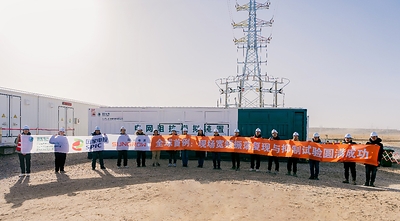
HEFEI, China, Sept. 17, 2026 /PRNewswire/ -- Sungrow, a globally leading PV inverter and energy storage system provider, recently has achieved a world first by controllably reproducing and successfully suppressing wideband oscillation at a real-world 500 MW solar-plus-storage plant in Qinghai, China. The field test marks a major step toward addressing one of the long-standing challenges facing renewable power systems as renewable penetration continues to increase worldwide.
As renewable penetration rises worldwide, wideband oscillation has become a major challenge, with severe cases potentially causing renewable plants to disconnect from the grid or shut down. In 2014, the BorWin1 offshore HVDC project in Germany experienced oscillations at 250–350 Hz, which damaged filter capacitors on the offshore converter platform and led to a shutdown lasting approximately six months, causing substantial economic losses to the local utility. In 2019, the Hornsea offshore wind farm in the UK experienced widespread disconnection due to subsynchronous oscillation, resulting in a loss of approximately 3.2% of the system load and affecting around one million users. Past incidents have demonstrated the significant impact of oscillation-related events.
However, the complex and unpredictable nature of the phenomenon has made it difficult to safely and controllably reproduce oscillations at real-world plants and validate effective suppression methods in the field. As a result, research has largely remained at the theoretical and simulation stage, with limited systematic validation in actual power plant environments.
To bridge this gap, Sungrow and its industry partners conducted a field test at the plant, using Sungrow PV inverters deployed across the site.
Controlled Reproduction of Wideband Oscillation
The test established weak-grid conditions and identified three key contributing factors—power output, system short-circuit ratio (SCR), and control parameters—before successfully achieving controlled reproduction of a localized system oscillation.
Rapid Suppression of Wideband Oscillation
The field test evaluated the oscillation suppression performance of Sungrow's PV inverters under different grid conditions. Leveraging Sungrow's patented grid-strength adaptation technology, the inverters identified grid strength within 40 milliseconds, adjusted their control strategies accordingly, and rapidly stabilized voltage and frequency.
The test also validated the effectiveness of grid-forming control in suppressing wideband oscillation. Sungrow's grid-forming control strategy enables stable operation across a wide SCR range of 1~40 and effectively mitigates transient overvoltage.
By successfully reproducing and suppressing wideband oscillation at a real-world 500MW plant, the field test marks a critical step in moving wideband oscillation suppression from the laboratory into engineering practice, with the potential to improve the stability of renewable energy plants under extremely weak grid conditions, prevent grid disconnections caused by oscillations, unlock greater power export capacity for plants connected to weak grids, and reduce generation losses.
"For renewable energy to become a truly stable and reliable source of power, it is essential to develop autonomous fault self-healing and grid-support capabilities." Pan Nian'an, Chief Engineer and Chief Expert for Utility PV BU at Sungrow, said Sungrow will continue to advance research and development in grid technologies, focusing on key innovations including wideband oscillation suppression, grid-forming control, and multi-energy coordination. These efforts aim to support the stable grid integration and efficient utilization of renewable energy while strengthening the technical foundation for a secure and stable energy transition and next-generation power systems.

 View original content to download multimedia:https://www.prnewswire.co.uk/news-releases/sungrow-achieves-world-first-wideband-oscillation-reproduction-and-suppression-at-500-mw-plant-302881815.html

Inflationssorgen und steigende Ölpreise haben Europas wichtigste Aktienmärkte zur Wochenmitte spürbar belastet und zugleich die Monatsbilanz eingetrübt. Der EuroStoxx 50 schloss am Mittwoch 0,81 Prozent tiefer bei 6269,02 Punkten. Im Monatsverlauf verlor der Leitindex der Eurozone 2,4 Prozent und beendete damit eine Serie von fünf Anstiegen in Folge. Der DAX gab um 0,79 Prozent auf 25.199,19 Punkte nach, während der britische FTSE moderat um rund ein Viertel Prozent auf gut 10.600 Zähler nachgab.
Treiber der Risikoaversion waren neue Inflationsdaten aus großen Euroländern. In Deutschland kletterten die Verbraucherpreise im September auf 3,3 Prozent gegenüber dem Vorjahr und damit erstmals seit Ende 2023 wieder über die Marke von drei Prozent, nachdem im August noch 2,9 Prozent verzeichnet worden waren. Starke Anstiege der Energiepreise wirkten als Hauptfaktor – eine Entwicklung, die sich nach ersten Angaben auch in Frankreich und Italien widerspiegelt. In Italien kam es zudem zu einem deutlichen Anstieg der Teuerung, was die Sorge nährte, dass der disinflationäre Trend im Euroraum ins Stocken geraten könnte.
Parallel dazu zogen die Ölpreise erneut an. Marktteilnehmer verwiesen auf die angespannte geopolitische Lage im Nahen Osten und mögliche Risiken für die Öllieferungen aus dem Persischen Golf. Berichte, wonach mehrere Tankschiffe in der Straße von Hormuz unter Beschuss geraten sein sollen, verstärkten die Nervosität. Höhere Energiekosten und im Umfeld der Inflationsdaten steigende Anleiherenditen machten Anleger nach Einschätzung von Marktstrategen europaweit selektiver. Ulrich Urbahn, Leiter Multi-Asset-Strategie und Research bei Berenberg, sieht dennoch Chancen für eine Jahresendrallye: Robuste Unternehmensgewinne könnten die Märkte stützen, sofern Firmen ihre Margen und Prognosen behaupten und sowohl Inflation als auch Renditen nicht weiter zulegen.
Im Branchenspektrum fehlten klare Impulse von den Technologiewerten, die nach Vortagesgewinnen überwiegend richtungslos tendierten. Viele Investoren warteten auf die anstehenden Quartalszahlen des US-Speicherchip-Herstellers Micron, die als Gradmesser gelten, ob der Boom rund um Künstliche Intelligenz weiterhin ausreichend im operativen Geschäft der Halbleiterbranche ankommt. Analyst Andreas Lipkow von CMC Markets warnte, eine Enttäuschung bei Micron könne die zuletzt gewachsene Skepsis gegenüber dem KI-Sektor rasch in neuen Verkaufsdruck umschlagen lassen. Einzelwerte wie BMW im DAX konnten sich diesem Umfeld zwar mit Kursgewinnen entziehen, insgesamt dominierte an den europäischen Börsen jedoch zum Monatsende die Vorsicht.