AG.AL claims the $7 million Club Championship title after seven weeks featuring more than 2,000 players, 200 Clubs and 25 tournaments
850 million viewers and 440 million hours watched, up 13% and 26% year-on-year, highlight record-breaking event
175,000 tickets sold to esports competitions, up 94% compared to 2025
Total visits across venues, Fan Fest and city activations top 2 million
VIDEO: Thank you, Paris
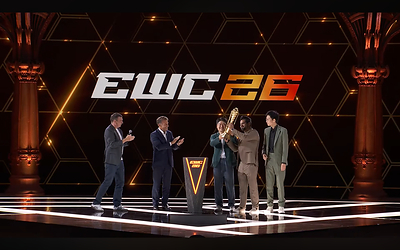
PARIS and RIYADH, Saudi Arabia, Aug. 24, 2026 /PRNewswire/ -- The Esports Foundation announced that AG.AL has been crowned Esports World Cup 2026 Club Champion, bringing seven weeks of competition in Paris, France to a close after more than 2,000 players, representing 200 Clubs and over 100 countries, competed across 25 tournaments in 24 games, for a record-breaking $75 million prize pool.

AG.AL secured the $7 million Club Championship title with 5,300 points after a dramatic win in Trackmania, completing a campaign that also included a first place finish in TEKKEN 8, second place finishes in Chess, Free Fire and the Honor of Kings World Cup, and a third place finish in Teamfight Tactics. Team Falcons finished second with 4,600 points, followed by Team Vitality with 3,300 points, Natus Vincere with 2,950 points, and Team Liquid with 2,700 points.
The title was decided on the final weekend, when AG.AL's Gwendal "Gwen" Duparc won the EWC's inaugural Trackmania tournament to secure the Club Championship. Two-time defending Club Champions Team Falcons entered the Trackmania playoffs leading the overall standings, but Carl-Antoni "Carl Jr." Cloutier's quarterfinal exit opened the door for AG.AL. Needing to finish third or better, Gwen dominated the final to claim the $130,000 tournament prize and the EWC 2026 Club Championship for AG.AL.
"We are proud of what the Esports World Cup has achieved in Paris and of its continued international growth," said His Royal Highness Prince Faisal bin Bandar bin Sultan al Saud, Chairman of the Executive Committee of the Esports Foundation. "Bringing the EWC to a global audience beyond Saudi Arabia marks an important milestone in its journey and reflects the growing recognition of esports as a global industry, connecting communities, cultures and audiences around the world. The attendance of His Royal Highness Prince Mohammed bin Salman bin Abdulaziz Al Saud, Crown Prince and Prime Minister, alongside President Emmanuel Macron, is a testament to the growing importance and global interest in esports, and to how far the industry has come. I extend my congratulations to all the players, Clubs, publishers, partners and organisers who contributed to this edition. Paris has been an important chapter in the EWC journey, and we look forward to building on this progress in the years ahead."
"When we began expanding AG.AL globally in 2024, the same year the Esports World Cup launched, we set out to build a Club capable of succeeding across games, regions and cultures. This title shows how far that vision has come," said Eddy Chen, COO at AG.AL. "Our journey in Paris reflected the strength of the entire organization, from M. Zubair's breakthrough in TEKKEN 8 and our deep runs across multiple titles to Gwen delivering the decisive Trackmania victory under extraordinary pressure. But this trophy belongs equally to every player, coach and staff member whose dedication brought us here. I want to thank our Chairman, Mr. Layne Le, whose belief and leadership made this journey possible, and the Esports Foundation for creating a global stage that rewards the depth and ambition of an entire Club. Winning the Club Championship is a historic milestone for AG.AL and a proud moment for everyone who believed in what we are building."
From start to finish, EWC Paris 2026 showcased elite play and the very best of esports, as legends rose and new stars were born. France's Caliste "Caliste" Henry-Hennebert led Karmine Corp on a fairytale run to the League of Legends Grand Final in front of a home crowd, while 15-year-old Chilean Jaime "Craime" Bustos defeated two EVO champions to become the youngest EWC champion in history.
AG.AL's Khawaja "M. Zubair" secured the TEKKEN 8 championship trophy while claiming the Jafonso Award for emerging from the LCQ to win the title. In the closing weeks, Samy "dralii" Hajji became the first-ever three-time EWC champion after his third victory in Rocket League, and grandmaster Magnus Carlsen repeated as Chess champion without losing a single game.
EWC Paris 2026 also established new records across the board compared to 2025. Distributed globally by more than 100 broadcast and OTT partners in 47 languages and supported by 5,000 participating creators and co-streamers, the EWC reached 850 million viewers and generated 440 million hours watched, up 13% and 26%, respectively, with peak viewership of 4.3 million registered during the League of Legends tournament.
The event generated 175,000 tickets sold to esports competitions, up 94% compared to 2025. Including venues, Fan Fest and city activations, 2 million total visits were recorded over the seven-week period.
The EWC 2026 was the culmination of a year-round competitive journey. More than 1.5 million players competed through 330 Road to EWC events, connecting publisher competitions, qualification pathways and the Club Championship into a global season that Clubs, players and fans could follow from the first qualifier to today's final trophy lift.
"Our ambition has always been bigger than a single event: to grow esports and establish it as a leading global sport," said Ralf Reichert, Chief Executive Officer of the Esports Foundation. "The Esports World Cup brings that mission to life by bringing the best games, players, Clubs and communities together on one global stage. Paris embraced the Esports World Cup and made it its own. The city showed that competitive gaming belongs on the world's biggest stages while staying true to what makes esports special. Thank you to the city of Paris for seven weeks of incredible support and fandom. And congratulations to AG.AL on an extraordinary Club Championship victory and on earning their place in esports history."
As the first Esports World Cup hosted outside Riyadh, Paris marked a significant step in the event's global evolution. French Clubs competed in front of sold-out home audiences, more than 22,600 campaign placements carried EWC across the capital to reach 94% of Parisians, and tournament symbols appeared at the city's most popular landmarks, including on the Champs-Élysées and beside the Eiffel Tower. Record ticket sales culminated with the final weekend's Counter-Strike tournament moving to the 20,000-seat Accor Arena.
The EWC's impact will continue beyond the competition weeks. A Memorandum of Understanding (MOU) between the Esports Foundation and the French Ministry of Sports, Youth and Community Life established a framework for long-term cooperation around youth development, digital skills, esports participation and French talent, building on the connection created between EWC and France this summer.
Paris now sends the Esports World Cup into its next era with new champions, new records and a global foundation for hosting in the world's leading cities. As the first international host city of the Esports World Cup, Paris will hold a permanent place in EWC history.
The Esports World Cup will return to Riyadh, Saudi Arabia, in 2027.
For more information, visit esportsworldcup.com and follow EWC on X and Instagram, and the Esports Foundation LinkedIn.
About the Esports World Cup
The Esports World Cup is the world's premier annual competition for elite esports Clubs and a global celebration of competitive gaming. Featuring a unique cross-game format that crowns the world's best Club across multiple titles, the Esports World Cup brings together the industry's leading players, teams, publishers and fans on one global stage. Hosted in Paris, France, in the summer of 2026, the Esports World Cup continues the Esports Foundation's mission to advance esports as a leading global sport.
 View original content to download multimedia:https://www.prnewswire.co.uk/news-releases/agal-crowned-esports-world-cup-2026-club-champion-after-landmark-competition-in-paris-302857840.html

Die Schweiz stimmt an diesem Wochenende über eine der umstrittensten Initiativen der vergangenen Jahre ab: „Keine 10-Millionen-Schweiz!“. Der Vorstoß der nationalkonservativen Schweizerischen Volkspartei (SVP), auch bekannt als Schweizerische Volkspartei oder Swiss People's Party, sieht vor, die ständige Wohnbevölkerung des Landes bis 2050 auf maximal zehn Millionen Menschen zu begrenzen. Nach ersten Hochrechnungen tendieren die Stimmbürgerinnen und Stimmbürger dazu, die Initiative abzulehnen – ein Ergebnis, das im Vorfeld keineswegs sicher schien.
Die Initiative, die in der Verfassung verankert werden soll, würde den Bund verpflichten, Gegenmaßnahmen zu ergreifen, sobald die Bevölkerung 9,5 Millionen erreicht. Die Schweiz zählte Ende 2025 bereits gut 9,1 Millionen Einwohner – rund 1,7 Millionen mehr als 2002. Haupttreiber des Wachstums ist die Zuwanderung. Rund 28% der im Land lebenden Menschen besitzen keinen Schweizer Pass. Viele stammen aus EU-Staaten wie Italien, Deutschland und Portugal, hinzu kommen Personen aus Drittstaaten, darunter Asylsuchende.
Unterstützer der Initiative argumentieren, das Land stoße an seine Belastungsgrenzen. Sie verweisen auf steigende Mieten, überlastete Verkehrswege, Staus sowie eine als problematisch wahrgenommene Entwicklung bei Gewalt und Kriminalität, die sie mit einer höheren Zuwanderung verknüpfen. Ziel sei es laut Kampagnenmotto, „zu bewahren, was wir lieben“. Die SVP wirbt mit auffälligen Aufklebern, Fahnen und Plakaten in Nationalfarben, um eine Begrenzung des Bevölkerungswachstums als Schutz der Lebensqualität zu präsentieren.
Gegen die Initiative stellen sich der Bundesrat, das Parlament, die Kantone sowie die meisten übrigen großen Parteien, gestützt von Wirtschaftsverbänden und Gewerkschaften. Sie warnen, ein starres Bevölkerungs- und damit faktisches Zuwanderungslimit könne den bereits bestehenden Arbeitskräftemangel verschärfen. Laut Bundesamt für Statistik waren im ersten Quartal 2026 rund 1,87 Millionen ausländische Erwerbstätige in der Schweiz beschäftigt. Etwa vier von fünf kamen aus EU- oder EFTA-Staaten oder dem Vereinigten Königreich, der Rest aus Drittstaaten. Viele arbeiten in Bereichen wie Gesundheitswesen, Bau und Gastgewerbe – Sektoren, die stark auf Personal aus dem Ausland angewiesen sind.
Ein weiterer Konfliktpunkt ist das Verhältnis zur Europäischen Union. Die Initiative sieht vor, dass die Schweiz in letzter Konsequenz das Abkommen über die Personenfreizügigkeit mit der EU kündigen müsste, sollte die Obergrenze sonst nicht zu halten sein. Gegner befürchten, dies könnte die bilateralen Beziehungen und den Zugang zum europäischen Arbeitsmarkt belasten. Befürworter halten dem entgegen, nur mit klaren quantitativen Vorgaben lasse sich der Druck auf Wohnungsmarkt, Infrastruktur und öffentliche Dienste nachhaltig begrenzen.
Parallel zur Abstimmung über die 10-Millionen-Grenze entscheiden die Stimmberechtigten auch über eine Verschärfung des Zivildienstgesetzes. Im Fokus der innenpolitischen Debatte steht jedoch vor allem die Frage, wie die Schweiz Wachstum, Wohlstand und gesellschaftlichen Zusammenhalt künftig austarieren will. Das Ergebnis der Volksabstimmung dürfte zwar die Initiative selbst klären, die Grundsatzdiskussion über Zuwanderung, Arbeitskräftebedarf und Lebensqualität in der Alpenrepublik jedoch kaum beenden.