ULAANBAATAR, Mongolia, Aug. 24, 2026 /PRNewswire/ -- From August 17 to 28, 2026, the 17th session of the Conference of the Parties to the United Nations Convention to Combat Desertification (UNCCD COP17) is being held in Ulaanbaatar, Mongolia. During the conference, LONGi participated in several side events, systematically presenting the enormous potential of PV technology to enhance the resilience of global food supply, and officially released its solutions for PV-powered food security.
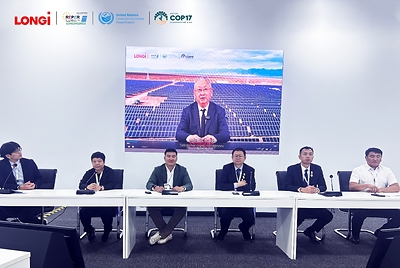
At a side event titled "From Desert to Asset – Comprehensive Solutions for Integrated PV-Based Ecological Restoration," co-hosted by the School of Social Sciences of Tsinghua University and the China Green Foundation, Li Zhenguo, founder and Chief Technology Officer of LONGi, joined via video link and noted that traditional food production relies heavily on natural photosynthesis and climatic conditions. Extreme weather events such as droughts and floods have severely impacted agricultural production, and global climate change is placing unprecedented pressure on an already fragile food supply system. However, as costs decline, PV technology can not only reduce carbon emissions but also offer a new solution for enhancing the resilience of global food supply.
Li Zhenguo recently published a forward-looking Perspective article titled "Photovoltaics for food security" in the leading international academic journal Nature Sustainability, in which he systematically set out two technological pathways with practical application prospects.
Pathway 1: PV-driven artificial synthesis of starch from carbon dioxide. PV-generated electricity is used to electrolyze water and produce green hydrogen, which is then coupled with captured CO₂ to synthesize green methanol. This methanol is subsequently converted into starch through oxidation, polymerization, and other processes. Compared with the solar energy utilization efficiency of about 2% in traditional natural photosynthesis, this pathway can raise efficiency to 7–10%. Calculations show that deploying PV on just 3.7% of the Sahara Desert could generate 26 trillion kWh of green electricity, enough to synthesize 3 billion tonnes of food and meet the current global food demand.
Pathway 2: PV-driven "energy-water-food" nexus system. By building PV power plants in desert areas, the shading effect of PV modules reduces soil moisture evaporation, improves the soil microclimate, and lowers irrigation requirements. Combined with PV-powered seawater desalination and inter-regional water transfer projects, this approach can gradually transform desert land that was previously unsuitable for cultivation into arable farmland.
In fact, LONGi has already been actively exploring this approach in the Kubuqi Desert in Inner Mongolia, China – generating electricity on the panels, planting crops under the panels, and raising livestock between the panel rows. Under the PV panels, the once barren land is being revitalized. This practice verifies the feasibility of integrated PV-ecology-agriculture development and provides a replicable Chinese solution for the coordinated development of ecological restoration and food production in desertification-prone areas.
The theme of this year's COP17 is "Restoring Land, Restoring Hope." LONGi actively participated in multiple side events, engaging in in-depth exchanges with government agencies, scientists, and corporate representatives from around the world, and sharing Chinese experience in the deep integration of PV with desertification control and ecological restoration.
From cutting-edge laboratory exploration to on-the-ground validation in deserts, PV is evolving from an energy solution into a cornerstone of sustainable development. Looking ahead, LONGi will leverage Solar (PV)-plus-Storage technologies to actively address climate change, continue to promote the deep integration of PV with ecology, agriculture, water resources and other fields, build a more resilient global sustainable development system, and ensure that more affordable, safer, and more accessible green energy truly benefits everyone.

 View original content to download multimedia:https://www.prnewswire.co.uk/news-releases/longi-at-unccd-cop17-li-zhenguo-explains-two-technological-pathways-for-pv-powered-food-security-302857978.html

Der Bundesrat verschärft im Streit um das Frühfranzösisch den Ton und greift zu einem bundesrechtlichen Instrument. Alle Primarschülerinnen und Primarschüler in der Schweiz sollen künftig zwingend eine zweite Landessprache lernen. Um dieses Ziel durchzusetzen, hat die Landesregierung eine Revision des Sprachengesetzes in die Vernehmlassung geschickt. Sie reagiert damit auf Vorstösse in mehreren deutschsprachigen Kantonen, Französisch aus den Stundenplänen der Primarschule zu streichen.
Im Zentrum steht die Frage, welche Rolle die Landessprachen im obligatorischen Unterricht spielen sollen. Für den Bundesrat ist dies eine «Frage von nationaler Bedeutung». Die Bundesverfassung verpflichte Bund und Kantone gemeinsam, die Landessprachen zu erhalten, die Verständigung zwischen den Sprachgemeinschaften zu stärken und nationale Minderheiten zu schützen, hält die Regierung fest. Der Bund sehe sich damit in der Verantwortung, den Zusammenhalt zwischen den Sprachregionen und den Respekt vor der sprachlichen Vielfalt zu sichern, während die Kantone ihr Schulwesen so zu harmonisieren hätten, dass Qualität und Durchlässigkeit des Bildungsraums Schweiz gewahrt bleiben.
Der Konflikt entzündet sich an der 2004 beschlossenen Sprachenstrategie der Kantone, die 2009 im HarmoS-Konkordat verankert wurde. Diese sieht vor, dass Kinder in der Primarschule zwei Fremdsprachen erlernen – darunter eine zweite Landessprache. In einzelnen Kantonen gibt es inzwischen Bestrebungen, den Unterricht einer Landessprache als Fremdsprache auf der Primarstufe zu streichen. Das widerspreche der gemeinsamen Strategie, schreibt der Bundesrat und zeigt sich über diese Entwicklung «beunruhigt».
Um gegenzusteuern, legt die Regierung zwei Varianten für eine Gesetzesänderung vor. Die erste folgt dem HarmoS-Modell: In der Primarschule sollen obligatorisch zwei Fremdsprachen unterrichtet werden, eine Landessprache und Englisch. Damit würde die heutige Praxis in den 15 HarmoS-Kantonen bundesrechtlich abgesichert und für alle gelten, sollte es nötig werden. Die zweite Variante lässt den Kantonen mehr Spielraum: Sie verpflichtet lediglich dazu, dass eine zweite Landessprache spätestens ab der Primarschule und durchgehend bis zum Ende der obligatorischen Schulzeit unterrichtet wird, ohne Englisch explizit als zweite Fremdsprache vorzuschreiben.
Mit der Revision will der Bundesrat den Rahmen abstecken für den Fall, dass die Kantone ihre Sprachenstrategie ganz oder teilweise aufgeben. Konkrete Entscheide sind noch offen: Zunächst läuft bis zum 5. Oktober 2026 eine Vernehmlassung, in der Kantone, Parteien und weitere Akteure Stellung beziehen können. Erst danach wird sich zeigen, ob sich das strengere HarmoS-Modell oder die flexibelere Lösung durchsetzt – und wie viel Gewicht der Bund seiner sprachpolitischen Rolle im Schulbereich tatsächlich geben will.