HONG KONG, Aug. 28, 2026 /PRNewswire/ -- On August 28, Unisound (09678.HK) announced its interim results for the six months ended June 30, 2026.
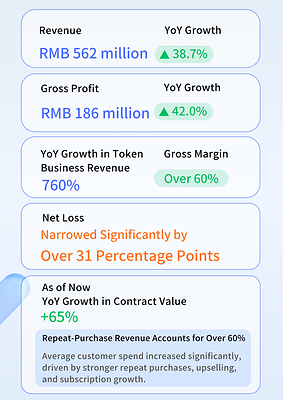
The results show that the company generated revenue of RMB 562 million in the first half of 2026, up 38.7% year over year, with commercialization accelerating across the board. Token business revenue increased by approximately 760% YoY, with a gross margin of over 60%, marking Unisound's entry into a phase of accelerated large-model commercialization as it moves from technological leadership toward value leadership.
Strategic Focus on Three Core Segments, Valuation Framework Shifts Toward a Platform Model
In the first half of 2026, Unisound sharpened its strategic focus on three core segments: Enterprise AI Services, Token Business, and Edge AI. Under the new structure, the company is moving beyond the label of a traditional AI project delivery provider and transforming comprehensively into an AI platform company. The value created by AI is no longer diluted by traditional businesses, fundamentally reshaping the company's valuation framework.
All three core segments delivered solid growth:
Enterprise AI Services: Comprising agent applications, agent platforms, and industry solutions, the segment generated RMB 478 million in revenue, up 35.7% YoY, further consolidating the company's industry-leading position.
Token Business: Revenue reached nearly RMB 30 million, with second-quarter revenue increasing by more than 500% quarter over quarter, making it a new growth engine for the company.
Edge AI: Revenue reached RMB 53.8 million, up 9.2% YoY, while overseas chip shipments increased 50% YoY, demonstrating strong growth resilience.
In terms of operating quality, revenue from repeat purchases accounted for more than 60% in the first half of the year, while average customer spend increased significantly. Repeat purchases and upselling from existing customers provided further support for revenue growth. During the reporting period, administrative expenses fell sharply by 37.8%, with all savings redirected to R&D. The net loss margin narrowed by more than 31 percentage points YoY, while overall gross margin remained stable with a modest increase. As of now, total contract value in 2026 has increased 65% YoY, the order backlog has exceeded RMB 1.5 billion, and cash reserves are approaching RMB 1.0 billion, making the path to profitability increasingly clear.
Architecture Upgrade Drives Platform Transformation, U2 Enters the Global Top Tier
During the reporting period, Unisound continued to enhance its three-layer architecture of "Foundation Capability Layer - Intelligent Construction Layer - Value Operation Layer." Its agent platform, UniAgentOS, has accumulated 1,773 agent instances, with a single module reused up to 119 times. Project implementation costs as a share of total costs fell from 21% in the same period last year to 17%. The revenue model has expanded beyond one-off project delivery to include platform subscriptions, usage-based calls, and ongoing operations, further strengthening revenue continuity.
On the technology front, Unisound has continued to expand the U-Model family around U2, driving ongoing breakthroughs in general-purpose foundation models, industry-specific models, and multimodal capabilities. Across the global LLM landscape, U2 has entered the top tier in multiple challenging benchmarks, spanning long-context understanding (AA-LCR), knowledge reasoning (GPQA Diamond), instruction following (IFBench), agent execution (SWE-bench Verified), and complex tasks (WildClawBench). Its overall performance ranks among the top 25 on LLM Stats and eighth among global model providers.
Going forward, Unisound will continue to pursue its "strong foundation models, deep applications" strategy, with a greater focus on post-training. The company will continue iterating U2 as well as models for the three healthcare domains, speech, and document intelligence. Leveraging its three-layer architecture, Unisound will further increase the reuse rate of agent modules and expand into more industries and regions. In a safe, compliant, and controllable manner, it will advance intelligence to greater heights and for the greater good, creating long-term value for society.
 View original content to download multimedia:https://www.prnewswire.co.uk/news-releases/unisound-2026-interim-results-revenue-up-38-7-yoy-token-business-surges-760-large-model-commercialization-accelerates-across-the-board-302862674.html

Der Bundesrat verschärft im Streit um das Frühfranzösisch den Ton und greift zu einem bundesrechtlichen Instrument. Alle Primarschülerinnen und Primarschüler in der Schweiz sollen künftig zwingend eine zweite Landessprache lernen. Um dieses Ziel durchzusetzen, hat die Landesregierung eine Revision des Sprachengesetzes in die Vernehmlassung geschickt. Sie reagiert damit auf Vorstösse in mehreren deutschsprachigen Kantonen, Französisch aus den Stundenplänen der Primarschule zu streichen.
Im Zentrum steht die Frage, welche Rolle die Landessprachen im obligatorischen Unterricht spielen sollen. Für den Bundesrat ist dies eine «Frage von nationaler Bedeutung». Die Bundesverfassung verpflichte Bund und Kantone gemeinsam, die Landessprachen zu erhalten, die Verständigung zwischen den Sprachgemeinschaften zu stärken und nationale Minderheiten zu schützen, hält die Regierung fest. Der Bund sehe sich damit in der Verantwortung, den Zusammenhalt zwischen den Sprachregionen und den Respekt vor der sprachlichen Vielfalt zu sichern, während die Kantone ihr Schulwesen so zu harmonisieren hätten, dass Qualität und Durchlässigkeit des Bildungsraums Schweiz gewahrt bleiben.
Der Konflikt entzündet sich an der 2004 beschlossenen Sprachenstrategie der Kantone, die 2009 im HarmoS-Konkordat verankert wurde. Diese sieht vor, dass Kinder in der Primarschule zwei Fremdsprachen erlernen – darunter eine zweite Landessprache. In einzelnen Kantonen gibt es inzwischen Bestrebungen, den Unterricht einer Landessprache als Fremdsprache auf der Primarstufe zu streichen. Das widerspreche der gemeinsamen Strategie, schreibt der Bundesrat und zeigt sich über diese Entwicklung «beunruhigt».
Um gegenzusteuern, legt die Regierung zwei Varianten für eine Gesetzesänderung vor. Die erste folgt dem HarmoS-Modell: In der Primarschule sollen obligatorisch zwei Fremdsprachen unterrichtet werden, eine Landessprache und Englisch. Damit würde die heutige Praxis in den 15 HarmoS-Kantonen bundesrechtlich abgesichert und für alle gelten, sollte es nötig werden. Die zweite Variante lässt den Kantonen mehr Spielraum: Sie verpflichtet lediglich dazu, dass eine zweite Landessprache spätestens ab der Primarschule und durchgehend bis zum Ende der obligatorischen Schulzeit unterrichtet wird, ohne Englisch explizit als zweite Fremdsprache vorzuschreiben.
Mit der Revision will der Bundesrat den Rahmen abstecken für den Fall, dass die Kantone ihre Sprachenstrategie ganz oder teilweise aufgeben. Konkrete Entscheide sind noch offen: Zunächst läuft bis zum 5. Oktober 2026 eine Vernehmlassung, in der Kantone, Parteien und weitere Akteure Stellung beziehen können. Erst danach wird sich zeigen, ob sich das strengere HarmoS-Modell oder die flexibelere Lösung durchsetzt – und wie viel Gewicht der Bund seiner sprachpolitischen Rolle im Schulbereich tatsächlich geben will.